Years of Faith & Legacy
The Battle Creek Tabernacle
Centennial Celebration
October 2–10, 2026 · A week of reflection, revival, and readiness
The Gathering
Schedule of Events
October 2–10, 2026
Opening Night Service
A powerful evening of singing early Adventist hymns and hearing amazing stories of our early pioneers.
Sabbath School
An amazing Sabbath School with stories from around the world and a panel study of this week's lesson.
Sabbath Morning Worship
A special Sabbath service celebrating 100 years of God's faithfulness.
Speaker
Erton Kohler, President, General Conference
Centennial Gala Luncheon
An elegant luncheon celebrating our local and world church family and community.
Sabbath Evening Vespers
A reverent close to the Sabbath with prayer, reflection, and sacred music.
Weeknight Revival Series
An inspiring series of evening services to renew our faith and commitment.
Speaker
Pavel Goia, Evangelist, Adventist World Radio (Sun–Wed)
Dr. Norman McNulty, Neurologist & Author (Thu–Fri)
Sabbath School
This Sabbath School will celebrate what God is doing in Battle Creek today and what He has in store for the future.
Closing Sabbath Service
Our grand finale service with a message of readiness and hope for the next century.
Speaker
Dr. Norman McNulty, Neurologist & Author
Centennial Luncheon
An elegant luncheon celebrating our church family and community.
Special Musical Concert
A sacred concert featuring beloved hymns and inspirational performances.
Special Guest
The King's Heralds
Our Heritage
A Century of Faith
For 100 years, the Battle Creek Tabernacle has stood as a beacon of faith, community, and spiritual growth in the heart of Battle Creek, Michigan. Since it was built in 1926 to replace the Dime Tabernacle, this building has been a gathering place where generations have come to worship, grow, and serve.
From its earliest days in the first meeting house, the Tabernacle has been more than a building — it has been a living testament to the power of God and the faith of His people. Through decades of change, it has remained a steadfast pillar of hope and inspiration.
In the fall of 1853, J. B. Frisbie, a traveling Methodist minister whom Joseph Bates had met and convicted regarding the truths of the Sabbath, moved from Chelsea to Battle Creek and bought two lots located on the northwest corner of Van Buren and Cass streets. In June of 1854, J. N. Loughborough and M. E. Cornell held the first tent meeting when they held meetings on the corner of Van Buren Street. Then in 1855 the most significant development came when James and Ellen White decided to accept an invitation to move the Review and Herald press and offices to a permanent home in Battle Creek.
The First Church · 1855–1857
The First Church
Fall, 1855 – November 1857
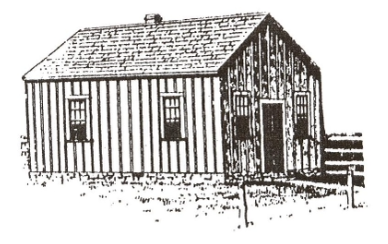
In the fall of 1855, the first Seventh-day Adventist church was built on the north end of Frisbie's property between Van Buren and Champion. It faced Cass Street and was an 18 x 24 foot building with 10 foot ceilings, built at a cost of $300, with comfortable seating for about 40. Called "The House of Prayer" by the early believers, it was built of upright board and batten siding with no inside finish except the floor. Believers in Battle Creek were poor and Ellen White states that "it took quite an effort to erect the building." The first congregation numbered about 42 with twelve of those being individuals who had come from Rochester, N.Y., with the Review and Herald. Many of those names are familiar to Adventists everywhere and to most of the settlers of Battle Creek. They include names such as James & Ellen White, G. W. Amadon, Uriah Smith, J. W. Bacheller, David Hewitt, Jonah R. Lewis, Elder J. B. Frisbie, Cyrenius Smith, J. F. Byington, Stephen Belden, and Henry Lyon among others. When no longer in use, this church later became a wing of a house on the corner and was torn down sometime after 1892.
The Second Church · 1857–1867
The Second Church (The Second Meeting House)
November 6, 1857 – May 11, 1867
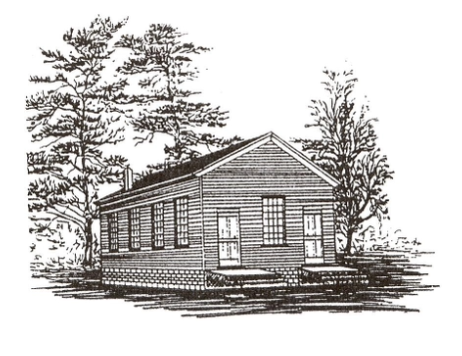
The second church was built just around the corner from the first church, on the lot next to the first church. Its opening faced Van Buren Street. It was 28 x 44 and cost $881. Following the Quaker custom of the day, this church had separate entrances for men and women who would sit on separate sides during worship. A replica was built in 1998 and today can be visited in the Historic Adventist Village. It was in this building that the tithing system was initiated in 1859. The denominational name Seventh-day Adventist, proposed by David Hewitt, was chosen in the second church by unanimous vote on October 1, 1860. Organization also took place here with the Michigan Conference and Publishing Association being organized in 1861, and the General Conference being organized May 21, 1863. It closed May 11, 1867, and the African Methodist Episcopal Church were using it by 1869. The AME congregation has continued to occupy and use the building to this day. It was used unchanged until 1906 when the AME congregation rebuilt their church on the same location.
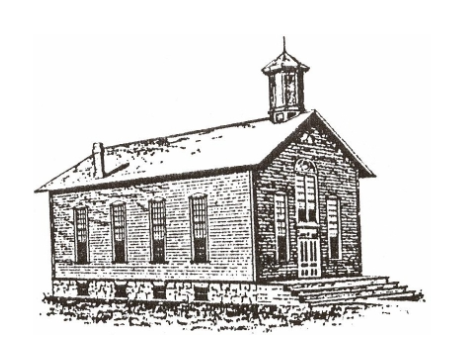
The Third Church · 1867–1878
The Third Church
1867 – 1878
On September 26, 1866, the third Battle Creek church was raised by a group of 85 men. It was the first of three churches that would be located on the current church lot. The opening of this church was on Washington Street facing McCamley Park. Work on the church was soon finished and the church opened for use in 1867 at a cost of $8,100. This church was a 40 x 65 foot wooden building, 23 feet high inside, and each family had a pew. It had a gallery inside over the entry which allowed it to seat about 700. Membership when the church was first built was about 300, but with the gallery there were often 500–600 people at the meetings held in this church. This was the first of our churches to have a cupola with a bell. Beginning with this church and continuing in churches to come for over a century, the bell would ring out over the city of Battle Creek signaling the beginning and ending hours of the Sabbath. In August of 1878, this church was moved across the street to be used by the Review. It was used at first for weekly chapel services, then became a paper warehouse. It was destroyed in the Review and Herald fires of 1902.
The Dime Tabernacle · 1879–1922
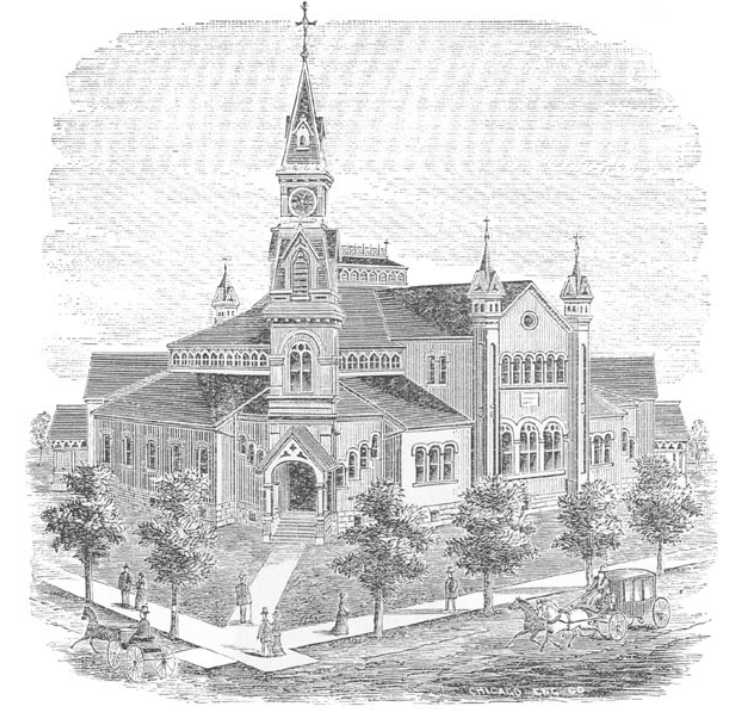
The Fourth Church — The "Dime" Tabernacle
April 20, 1879 – January 7, 1922
The fourth Adventist church built in Battle Creek became known as the "Dime Tabernacle" because church members and the community were invited to give dimes in support of the building project. This idea was suggested by James and Ellen White's second son, James Edson White, and since this was a church used by the denomination for gatherings and general meetings, members were encouraged to save a dime a month for a year to contribute to the project. We had about 15,000 members worldwide and many sent their dimes and helped with this project. It was at General Conference in March, 1878, that a vote was taken to build a larger church because of the increases in numbers being seen from the Sanitarium and the Review and Herald. The foundation stones were laid August 19, 1878, and construction was completed the next year at a final cost of $26,275 with all the furnishings, according to J.N. Loughborough.
The Dime Tabernacle was a brick-faced building with a size of 105 x 130 feet. It had a 108-foot clock tower that was donated by the members of the community. The main auditorium could seat 900 persons, and the gallery another 1,450 with wall seats and extra chairs. There were six large Sabbath School rooms and an office surrounding the auditorium. By raising glass partitions in these rooms at the back of the auditorium, another 850 seats could be added from the north, east, and south vestries, giving the entire building a seating capacity of 3,200. It was dedicated on April 20, 1879. At the dedication services, by seating people on the steps and adding extra chairs, there were 3,649 people in attendance by actual count.
Four entrances provided access and exit. The auditorium pews were heavily padded, with movable benches and chairs in the rooms in the rear. Two graceful staircases led to the gallery area. Overhead there was a large dome of richly colored glass of beautiful design and behind the pulpit were three stained glass windows that portrayed the Ten Commandments. A baptismal pool was under the platform in front of the choir space. This church was considered to be a fitting climax to the career of James White. He accepted the General Conference presidency for the last time that year, and died in 1881.
Records in 1898 show a church membership of 1,400 with another 288 who had yet to transfer their memberships from their home churches. There is a Sabbath School membership of 1,133 with 173 classes listed. The Tabernacle continued to serve as a major meeting place for large gatherings of Seventh-day Adventists. It was also used by the community for major large meetings. Evangelists Moody and Sankey spoke there, along with many other well-known names. The funerals of both James and Ellen White were conducted in this church. Also, several General Conference sessions were held in the Tabernacle, including the important 1901 session during which the church organization was restructured.
The fires of the Battle Creek Sanitarium (February 18, 1902) and the Review and Herald (December 30, 1902), along with counsel from Ellen G. White, finally caused Adventists to begin to decentralize. The educational work had already moved its center to Berrien Springs prior to the fires. Many saw the fires as divine judgments from God. The Dime Tabernacle continued to be our most prominent church and was used extensively for many years until it too was destroyed by fire on January 7, 1922. The value of the building was estimated at $85,000, but there was only $20,000 in insurance. The local newspaper announced on Monday morning, Jan 9, 1922, that a new tabernacle would be rebuilt — and it was.
The Current Tabernacle · 1926–Present
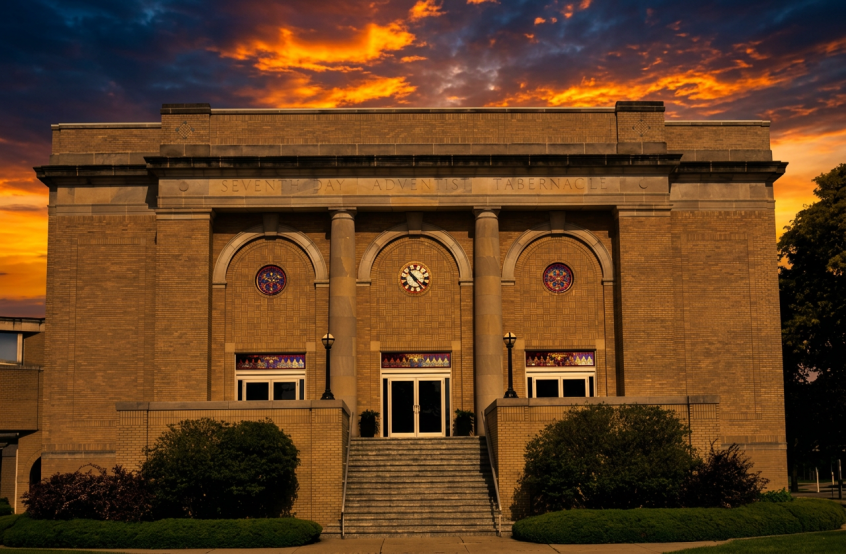
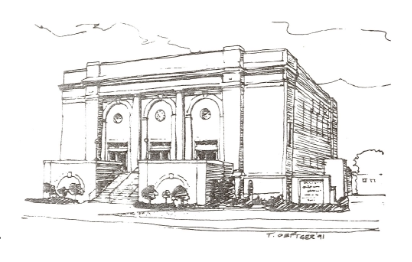
The Fifth Church — The Current Tabernacle
October 9, 1926 – Present
The replacement for the Dime Tabernacle was the current Tabernacle building which was built on the same lot, but slightly to the east of the old Dime Tabernacle foundation and closer to Van Buren, with the entrance facing Washington Avenue. Designed by A.B. Chanel, then Battle Creek's leading architect, it is constructed of brick, concrete, and iron. It was built at an estimated cost of $150,000, with seating for 1,100. In 1923 the congregation sold off the southeast portion of their lot to the City National Bank & Trust Company for $30,000 to help in financing the rebuilding efforts. The current building was dedicated October 9, 1926. After the fires and decentralization of the church from Battle Creek, many members moved away, but the church still held a prominent place in the city and denomination. Membership in 1932 was recorded at just under 1,000.
Notable Milestones
- —Grand piano from the Post Estate added to the sanctuary
- —1938 — Public address system installed in auditorium
- —1942–43 — Stained glass windows and mural of Christ with the Rich Young Ruler added
- —1950 — Skylight in sanctuary covered with a new roof
- —1954–55 — Southeast corner lot repurchased from bank and store for church annex
- —1958 — Bridge from Tabernacle to annex added
- —1961 — Pipe organ added in the sanctuary
- —1967 — Front entrance and steps modified; new bathrooms constructed and refurbished
- —1973 — Reconstruction of the ramp to sanctuary
- —1997 — Elevator added to service three levels
- —2023 — October 2023 Sanctuary Renovation completed
This October, we invite you to join us as we celebrate this remarkable milestone — a week-long celebration of reflection, revival, and readiness for the future.
1926
Battle Creek, Michigan
Reach Out
Contact Us
Address
264 W. Michigan Ave. Battle Creek, MI 49037
Phone
(269) 968-8101
office@bctab.com
Event Dates
October 2–10, 2026